Concepts or aphorisms on fabrics and clothes

Concepts or aphorisms on fabrics and clothes

For many years, African countries were colonies of European ones, so it was believed that African languages did not have their own written language, or their written forms appeared already in the modern world.
Best Betting Sites : sportsbooks in south africa
And, if in Europe graphic design, after the discovery of printing, was widespread, then in Africa there were no printed materials for many years. They subsequently spread along with advertising.

At the same time, in Africa there are many writing systems, as well as various concepts on clothes, in ceramics, and graphics on buildings. The alphabets of African languages were created in Guinea in the last century. This is the most valuable historical heritage, which is in letters and symbols, which must be treated with great care. Modern graphic designers must look to ancient traditions and aphorisms for inspiration, as Saki Mafundikva emphasizes.

What language do the Tuareg speak

Tuareg live in many African countries, mainly in the Sahara Desert. Their way of life is little known to Europeans. The Tuareg language is called Tamashek and belongs to the Berber languages. The Tuareg have a special “feminine” letter “tifinagh”, which originates from the ancient Libyan letter.

A very interesting written form in which words follow one another without interruptions, they are read even vertically, even horizontally. The geometric shapes of this letter can be carved into stone or simply painted on any surface. In different parts of the continent, the symbols of this writing are slightly different from other areas.

Sportsbook in africa: https://www.telecomasia.net/za/best-betting-sites-in-south-africa/

Pierre Di Sciullo, a French typographer, has developed fonts that can be used to write Tifinagh.

African alphabets

In Africa, there are many languages spoken by the locals. Let’s get acquainted with some of them:

What language do the Tuareg speak

• The Bambara alphabet is spoken by about three million people in different countries of the African continent, such as Mali, Guinea, Senegal and others. It was deciphered in the thirties of the last century.

• Nsibidi is the script used in Nigeria. It was invented in southern Nigeria in the eighteenth century for a secret society. The characters of this alphabet were engraved on objects or drawings on clothes by a special staining method.

• In 1930, the Loma syllabary was created, where the sign denoted the syllable and the text was read from left to right.

• The Vaï language is spoken by the Vaï people of Liberia. It is based on the symbols used by the elderly in various rituals. Vaï is written in a syllabary, but not in Latin or Arabic script. It was created in the 18th century. Used to print the New Testament in the Vaï language.

• Ndebele is a small people in South Africa, using the Bantu alphabet, living in the Transvaal and Zimbabwe. Ndebele women beautifully decorate the walls of houses with colorful symbols and geometric patterns. Their culture is protected by UNESCO as a cultural heritage.

• The Adinkra alphabet originates from the peoples of Ghana. Rare symbols of this alphabet were found even before the colonization of the continent, that is, they are very ancient. These signs are the culture of the nation at the present time.

Visual language of wax wool

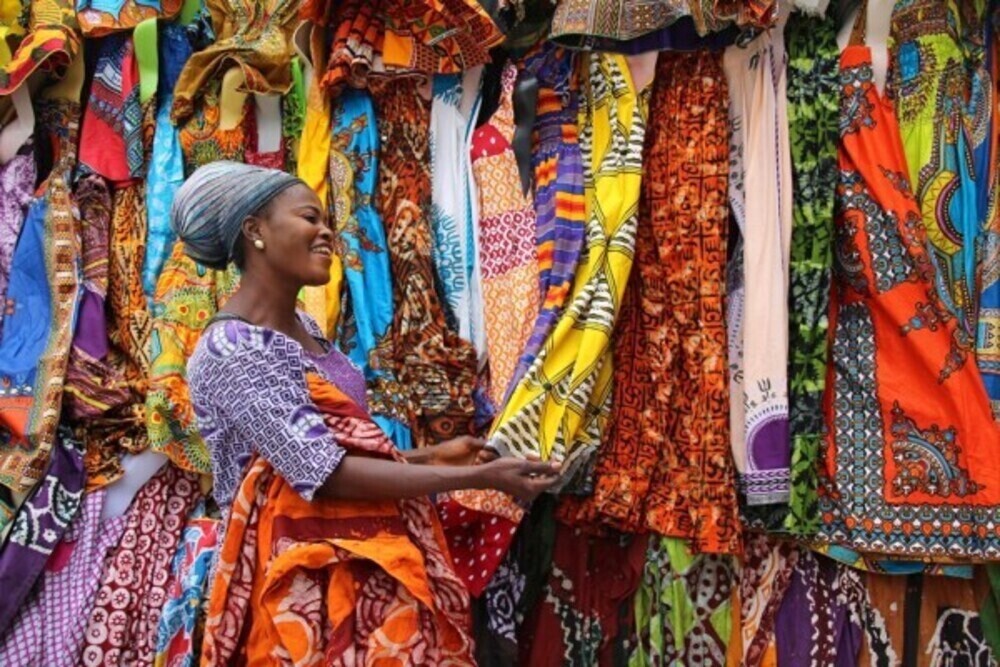
On the African continent, wax wadding is a popular design language. This is a special wax technique for applying a pattern to a fabric. The size of the pattern is measured by the loincloth, which corresponds to one yard of fabric.

Wax cotton was invented in Indonesia and brought to Africa in the twentieth century. Such loincloths were very popular with African women and quickly spread throughout the continent. The patterns showed historical events, habits and customs of the local population, sayings and aphorisms.

Visual language of wax wool

The patterns depict symbols, objects, animals and even people, including famous ones like presidents or musicians. Each region has its own meaning. The Vlisco Group, which manufactures and sells these fabrics, maintains a website where you can learn the meaning of various symbols and patterns.

The fashion for wax wadding spread so quickly that women selling loincloths on the market made good money on it.

Wax cotton is used for both casual and formal wear. Young people most often wear ordinary denim clothes in everyday life, but for special occasions they choose clothes made of waxed cotton, creating special patterns for this.

Recently, wax wool has been spreading all over the world. Such fabrics with a pattern appear on furniture and other items not only in Africa, but also on other continents.